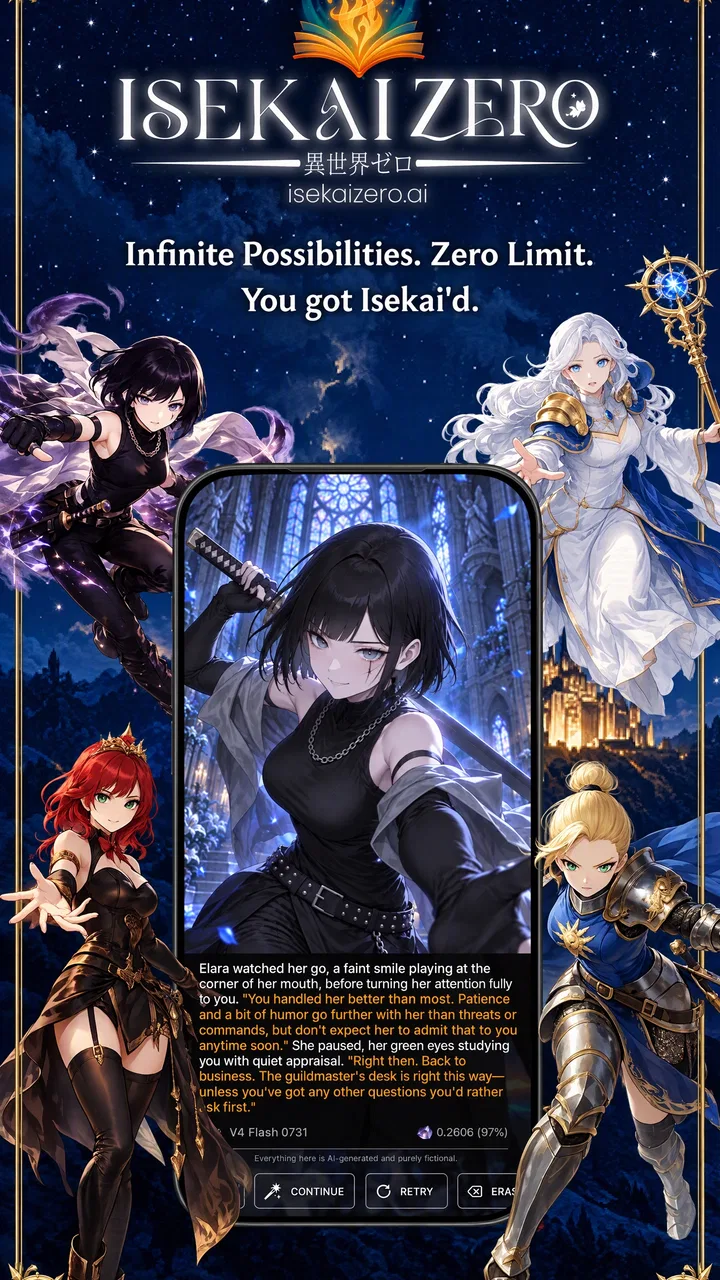
ISEKAI ZERO: Anime AI Roleplay
- 4.8
- Rating
- 100.00K
- Installs
- Free
- Price

 Analysis by App-foxy
I spent time with ISEKAI ZERO: Anime AI Roleplay as an entertainment app, and its appeal became clear quite quickly: it turns a chat with an anime-style character into an ongoing, playable story. Instead of choosing dialogue from a fixed menu and watching the same scenes unfold, I could write what I wanted to say, decide how my character would react, and see the conversation move in a more personal direction. It feels closer to improvising inside an isekai story than to reading a conventional visual novel.
That freedom is also the reason this app will not suit everyone. It works best when I treat each conversation as collaborative storytelling rather than as a game with a perfectly predictable route. The experience depends on how clearly I write, how much patience I have for roleplay, and whether I enjoy shaping a scene one message at a time. If you prefer fast action, a fully scripted plot, or a traditional anime game with precise objectives, this is probably not where I would start.
It is free to install, belongs to the entertainment category, and comes from ARX MEDIA SDN BHD. The app is intended for mature users aged 17 and over, which is important before handing it to a younger player or treating it as a general family chat app. Its current version is 1.1.9, and it runs on Android 7.0 or later. The visible audience response is strong, with a 4.8 average from around 8,100 ratings, while the install count has passed 100,000.
You May Also Like

 Blood Strike: 2.5 Anniversary
Blood Strike’s Loadouts Turn Every Drop Into a Tactical Gamble
A close look at Blood Strike’s custom loadouts: how fast access to signature weapons reshapes its battle royale rhythm, rewards preparation, and narrows the gap between fights.

 Pandora - Music & Podcasts
Pandora’s Music Is Easy to Start, but Harder to Recover
Pandora’s strength is its low-effort path from a seed to a station. Its weak spot is how much confidence it asks you to place in connection, setup, and quiet recovery.

 8 Ball Pool
 Is Built on Rivalries, Rematches, and Routine
A close look at the rivalries, rematches, shared routines, and unanswered safety questions that turn a quick pool match into a persistent mobile community.

 Samsung Music
’s Quiet Strength Is Playing What You Already Own
Its reach comes less from spectacle than from dependable access to a personal library. That simplicity is both the app’s strongest retention engine and its ceiling.

 AccuWeather: Weather Radar
AccuWeather Review: A Quick, Clear Forecast for Everyday Decisions
For everyday plans, the best forecast is the one you can understand quickly. AccuWeather makes rain timing, radar, and local conditions easy to act on, with a few trade-offs.

 Hill Climb Racing
Why Hill Climb Racing Still Turns Crashes Into One More Run
A tiny car, a bumpy hill and one more upgrade: Hill Climb Racing keeps resurfacing because its simple chaos makes every near-miss feel personal.
More From Our News Desk



How I built a reliable roleplay routine
I treat a reliable roleplay routine as a way to make each return feel intentional, not as a rulebook for every conversation. I keep the next decision visible, carry forward only the details that matter, and leave myself an easy point of entry for the next session. That small bit of preparation also helps me tell whether a pause or slowdown comes from the app itself or from the scene I have set up.
Starting with a small, clear premise
My first useful discovery was that the opening message matters more than I expected. A vague prompt such as “start an adventure” gives the character too much room to choose the tone, setting, and pace. I had better results when I supplied three simple ingredients: who I was, what immediate problem was happening, and what kind of mood I wanted. For example, I could describe myself as a reluctant traveler, place the scene at a dangerous border town, and ask for a tense but curious opening.
This does not require a long biography. In fact, I found that overexplaining my character at the beginning made the exchange feel stiff. A short identity, one motivation, and one limitation were enough to create a direction. The limitation was especially useful. Saying that my character did not trust magic, could not fight well, or was trying to hide a secret gave the conversation something to work with without forcing a complete plot outline.
I also learned to separate action from speech. Writing a line of dialogue followed by a brief action made my intentions easier to understand than mixing everything into one dense paragraph. That habit helped when I wanted to test a choice, change the mood, or make my character hesitate. It also made the story easier for me to follow later, because I could see what my character had actually done rather than relying on a loose stream of conversation.
Using the app as a story partner, not a search engine
The most enjoyable sessions happened when I gave the character room to respond instead of asking for information in a series of disconnected questions. I could ask what a fictional city looked like, but the answer felt more useful when I arrived there in the story and noticed a strange market, a guarded gate, or a character behaving suspiciously. The app is strongest when the question has a dramatic reason to exist.
That distinction also explains why it compares differently with ordinary entertainment apps. A streaming anime gives me polished pacing, visual direction, and a fixed performance. A conventional role-playing game gives me systems, objectives, and dependable rules. This app gives me conversational flexibility, but I have to supply some of the structure myself. I am not simply consuming a finished story; I am helping keep one coherent.
For an everyday scenario, I found it easy to use during a short break when I wanted something more engaging than scrolling through short videos. I could return to a scene, write a few lines, and stop at a natural pause. It did not demand a long uninterrupted play session. However, a short session worked best when I left the characters in a clear situation, such as preparing to enter a ruin or deciding whether to trust an ally. Ending in the middle of an unclear exchange made it harder to regain the thread later.
Keeping a lightweight continuity note
One of my most practical habits was maintaining a tiny note outside the app with names, relationships, promises, and unresolved problems. I did not record every line. I only kept the details that would change my next decision: who owed whom a favor, which location was dangerous, and what my character had already admitted. This is a simple workaround, but it makes a noticeable difference in a long roleplay.
I would not assume that every earlier detail will remain equally prominent forever. Conversational storytelling can drift, especially after a long exchange or a sudden change of subject. When an important fact mattered, I restated it naturally inside the scene instead of complaining about continuity. For example, I could have my character refer to the promise made at the inn, then ask the companion how they intended to honor it. That both refreshed the context and moved the plot forward.
This is one of the app's less obvious trade-offs. The freedom to write almost anything can produce surprising turns, but it also means I have to act as an editor. Users who enjoy shaping scenes, correcting direction, and preserving their own continuity will probably find that rewarding. Users who want the app to remember every detail without guidance may become frustrated.
Settings I would check before settling in
I recommend looking through the available settings before starting a serious story, especially because the app is aimed at mature users. I would check how the conversation is presented, whether notifications are useful for my routine, and which account or purchase controls are visible on the device. These checks do not make the roleplay better by themselves, but they prevent small interruptions from breaking the mood later.
The mature age rating deserves more than a passing glance. I would not treat the app as suitable for children simply because the interface resembles a friendly anime chat. Adults should also decide what kind of roleplay they are comfortable exploring and stop a scene when it becomes unpleasant or repetitive. The best experience comes from setting my own boundaries rather than assuming every character or situation will automatically match them.
Cost is another setting-related consideration. The app is free, but optional in-app purchases range from $2.99 to $146.99 per item. That is a wide enough range for me to recommend checking purchase confirmation and device restrictions before experimenting. I would use the free experience first, decide whether the conversational format genuinely holds my attention, and only then consider spending. Paying cannot fix a mismatch between the app's roleplay style and my personal preferences.
Shortcuts that make each exchange more productive
I found that a repeatable message pattern helped me avoid wandering conversations. I would state the immediate action, add the emotion behind it, and finish with a question or decision that required a response. In practice, that meant writing what my character did, why they did it, and what they wanted the other character to reveal. This produced more useful turns than sending several small questions with no dramatic context.
Another effective pattern was offering two possible reactions while leaving room for a third. I might say that my character could confront the guard or quietly follow them, then ask what the companion noticed. This gave the scene momentum without turning it into a rigid multiple-choice game. It also helped me test the character's personality: a cautious companion might recommend observation, while an impulsive one might push for immediate action.
When the conversation became too agreeable, I introduced a specific obstacle rather than asking the character to “make it more interesting.” A locked door, a conflicting promise, or an unreliable witness gave the exchange something concrete to solve. This is a useful tip for experienced users because it changes the quality of the response without requiring a complicated prompt. The app has more to work with when the problem is tangible.
I also learned not to correct every small inconsistency immediately. Interrupting the scene for every minor mistake made the roleplay feel like technical maintenance. Instead, I corrected only details that affected the next decision. If a character used the wrong location name but the emotional direction still worked, I carried on. If the mistake changed who possessed an important object, I restated the correct version in character. That balance kept the story moving while protecting the parts that mattered.
Where the freedom starts to show its limits
The app's conversational format is flexible, but flexibility is not the same as a complete game system. I did not approach it expecting carefully balanced combat, a visible inventory, or the strategic certainty of a traditional role-playing title. Its main pleasure is the exchange itself and the imaginative space around it. If I want precise rules, measurable progression, or a plot that cannot be redirected, a conventional game is the better choice.
There is also a pacing limit. A strong opening can lose energy if I keep asking for more description without making decisions. I had to take responsibility for moving the scene forward. Choosing a destination, accepting a risk, or revealing a secret was usually more effective than requesting another paragraph about the surroundings. The app can support a story, but it cannot replace the user's willingness to make meaningful choices.
Long sessions require some discipline as well. When I changed the subject abruptly, the roleplay could feel less focused. I got better results by closing one scene before opening another. A simple transition such as “after leaving the market, we reach the river” established a clean handoff. This is particularly helpful for users who want a continuing isekai adventure rather than a collection of unrelated chats.
I would also skip this app if I mainly want passive entertainment. It is not a substitute for watching an anime episode while doing something else. Reading and writing are central to the experience, and the quality of the session depends on participation. Someone who enjoys anime aesthetics but dislikes typing may prefer a visual novel, an animated series, or a standard mobile game with tap-based choices.
Who will get the most from it
I think it is a good fit for fans who enjoy character-driven anime, improvised fiction, and the fantasy of entering another world without being locked to a single protagonist. It can also work for writers who want a low-pressure way to test a character voice or explore a scene before developing it elsewhere. The app is less useful as a formal writing tool, but it can expose weak motivations quickly: if I could not explain why my character made a choice, the scene often stalled.
It is also suitable for people who prefer flexible sessions. I could play for a few minutes, return later, and continue from a clear situation. That makes it different from a competitive mobile game, where missing a session may affect progress or place me behind other players. Here, the pressure is mostly creative rather than competitive.
On the other hand, I would recommend a different option to anyone seeking multiplayer interaction with real people, highly polished animation, or a guaranteed canonical storyline. This is a personal roleplay experience with AI characters, not a replacement for a social community or a fully authored anime production. That distinction is important because the store summary may sound broader than the actual day-to-day activity: most of my time was spent reading, deciding, and writing rather than watching scenes play out.
What I would do before paying
My approach would be simple. I would install the free app, try one short conversation with a clear premise, and then test whether the same character can support a second scene without losing the tone I wanted. I would also try a deliberately different situation, such as moving from a quiet conversation to a tense decision. That shows whether I enjoy the app's underlying format or only liked the novelty of the first exchange.
If the experience feels repetitive, I would change my prompts before assuming the app has nothing more to offer. Adding a concrete conflict, a personal objective, or a meaningful consequence often produced better material than repeating “continue.” If it still does not hold my attention after those adjustments, spending more would not be sensible. The purchase range makes self-control particularly important, and the free starting point gives users a reasonable chance to judge the fit first.
My verdict after learning its rhythm
ISEKAI ZERO: Anime AI Roleplay works best as an interactive storytelling space for people who want anime-inspired characters to respond to their own ideas. I liked the way a simple premise could become a personal adventure, and I appreciated that I could choose the tone and direction instead of following a fixed route. The strongest sessions felt surprisingly intimate because the story reflected the choices I made rather than asking me to select from a narrow set of prepared answers.
Its weaknesses are tied to the same design. I had to guide the pacing, protect continuity, and accept that conversational freedom does not provide the structure of a full role-playing game. The mature rating and optional purchases also mean I would approach it thoughtfully, particularly on a shared device or around younger users.
My recommendation is to try it if you enjoy writing your way into an anime world. Start with a compact character idea, establish one immediate problem, keep a short continuity note, and use decisions instead of endless requests for description. With that habit, the app becomes much more than a novelty chat. Without it, the experience may feel unfocused. For me, it is a worthwhile free entertainment app when I want an imaginative break and am willing to be an active participant in the story.
FAQs for ISEKAI ZERO: Anime AI Roleplay
01What is ISEKAI ZERO: Anime AI Roleplay?
ISEKAI ZERO: Anime AI Roleplay is an interactive anime-style roleplaying app built around AI-powered conversations and storytelling. After creating or selecting a character, you can chat, make decisions, and guide scenarios that develop according to your responses. It is designed for users who enjoy immersive fantasy worlds, character-driven adventures, and flexible roleplay rather than a traditional level-based game.
02How does the AI roleplay experience work?
The app generates conversations and story developments based on the messages you send and the choices you make. You can interact with anime-inspired characters, explore different situations, and influence the direction of the narrative through natural language. Because the experience is AI-generated, replies may vary between sessions and occasionally feel unexpected, so it is best viewed as an open-ended roleplay experience rather than a fixed storyline.
03Is ISEKAI ZERO suitable for children and teenagers?
Parents should review the app’s current age rating, content description, and privacy information before allowing younger users to install it. AI roleplay can sometimes produce mature themes, intense conversations, romance, or unexpected responses depending on the scenario and user prompts. The app may be more appropriate for older teenagers or adults, and parental supervision is recommended when children have access to open-ended AI chat features.
04Does ISEKAI ZERO require an internet connection or include purchases?
AI-based roleplay generally requires an active internet connection because conversations and generated responses are processed through online services. Availability of the app’s features may also depend on account access, service status, and regional restrictions. Before downloading, check the Google Play Store or Apple App Store listing for subscription details, in-app purchases, limits on messages, advertisements, and any premium characters or content.
05What privacy considerations should users know before using the app?
Since the app relies on conversational interaction, users should read its privacy policy before sharing personal information. Avoid entering real names, addresses, passwords, financial details, private photographs, or sensitive personal experiences into roleplay chats. Review the permissions requested during installation and check whether conversations may be stored, analyzed, or used to improve the service. Privacy practices can change, so consult the latest store listing and official policy.
Pros
- Personalized AI conversations with anime-inspired characters.
- Creative roleplay supports many different story scenarios.
- Easy-to-use chat interface for quick
- casual sessions.
- Good choice for fans of interactive anime-style fiction.
- New dialogue paths can make repeated chats feel different.
Cons
- AI responses may occasionally feel repetitive or inconsistent.
- Some features or characters may require in-app purchases.
- Roleplay quality depends heavily on the prompts you provide.
- Privacy details should be checked before sharing personal information.
- Long conversations may lose continuity or forget earlier details.

ISEKAI ZERO: Anime AI Roleplay
Gallery